
East Coast Road — A Home Formed by Light, Memory, and Quiet Modernity
- Third Paragraph Marketing
- Dec 11, 2025
- 3 min read

Updated: Feb 10
Some homes speak immediately; others take a moment before revealing their quiet depth., East Coast Road belongs to the latter. It is a residence shaped not by ornament or spectacle, but by the gentle discipline of restraint — a home where space is allowed to breathe, where materials sit in soft conversation, where light becomes the most honest form of decoration.
The homeowners wanted a place that carried the calm of the East Coast without falling into nostalgia. They asked for a home that felt collected, not curated; warm, but not sentimental; modern, yet rooted in the subtle rhythms of the neighbourhood they had always loved. The design began with a single intention: to create an interior that feels settled — as though it has always existed in this state of quiet composure.

The living area embraces this intention completely. Walls, once heavy with visual noise, were pared back to a matte, tactile finish that absorbs light rather than reflects it. This allows the daylight to soften naturally, settling into the room like a slow exhale. A palette of pale timber, warm stone, and muted fabrics unfolds without insistence. The space becomes calm not through emptiness, but through clarity — each element placed with purpose, each line contributing to a gentle, grounding rhythm.
In the dining area, this clarity deepens. A slender, sculpted table anchors the space; its timber grain catches the morning light in a way that feels unforced and familiar. Above it, a quiet pendant hovers — not as a statement, but as an atmospheric gesture, introducing a warm halo that draws the homeowners back to the table long after meals have ended. The East Coast breeze, softened through sheer black blind curtains, moves through the room with a kind of architectural intention, reminding the interior that its context is as much a material as wood or stone.

The kitchen carries the same language of restraint. Warm taupe cabinetry meets softly veined counters, creating a tonal dialogue that feels steady and mature. Instead of relying on contrast, the design leans into tonal harmony, letting texture and proportion take precedence. Brass accents, subtly aged, introduce a quiet touch of history — a nod to the character of East Coast shophouses, reinterpreted through a contemporary lens. Every surface is deliberate. Every junction, calm.
Movement through the home is guided by softened edges and uninterrupted sightlines. Corners curve gently, allowing the eye to rest; built-ins sit flush, allowing space to lead. The home’s transitions are intentionally understated — not corridors, but pauses.

These moments of stillness allow the architecture to breathe, offering the homeowners a subtle, grounding rhythm after long days outside.
The bedroom adopts a deeper, more enveloping tone. Here, muted greys and warm taupes create an atmosphere of quiet retreat.
A fabric-wrapped headboard stretches across the wall, adding depth without decoration. Under soft, diffused lighting, the room becomes a sanctuary — a space where the weight of the day dissolves into calm. Nothing here seeks attention; the luxury lies in the restraint.
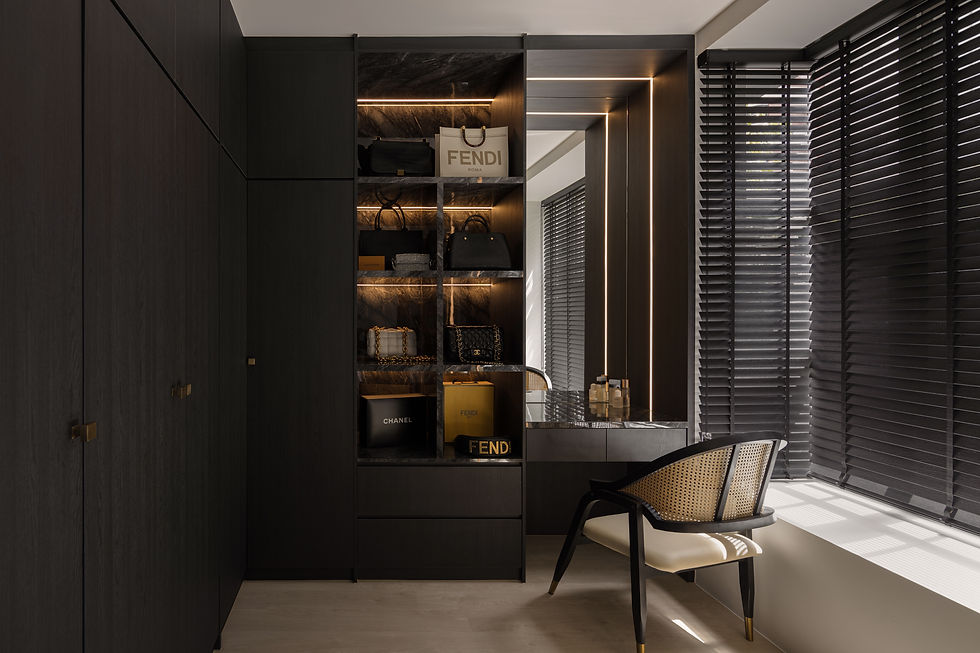
Throughout the home, carpentry is treated less as storage and more as architectural form. Lines are kept clean, junctions precise, silhouettes softened. Open shelves hold only what matters — a ceramic vessel, a framed memory, a single sculptural object.

These touches do not decorate the home; they anchor it.
East Coast Road is not a dramatic transformation. It is a quiet calibration — a tuning of light, material, and space until the right emotional resonance is found. The home now carries the qualities of the coastline it sits near: a sense of openness, a softness in movement, an ease that requires no explanation.
It is a home built on restraint, but filled with presence.A home shaped not by excess, but by intention.A home that stands still in all the right ways.


Comments